Introduction
Across the airlines on the ETS AERO platform, we calculate approximately EUR 2 billion in annual carbon liability. That is not a projection – it is the number our system computes daily, tied to real tonnes of CO2, priced by markets that move every day.
And yet most operators still manage aviation emissions compliance with spreadsheets, email chains, and a compliance officer who inherited the job from someone who left two years ago. In 2026, that stops being sustainable.
This guide is the full picture: every scheme an airline flying into or out of Europe must comply with, what changed this year, the real financial exposure – and how the best operators are managing it.
Key numbers at a glance
- EUR 2 billion+ – annual carbon liability across the aviation industry.
- 5 – regulatory schemes airlines must comply with.
- EUR 100/tonne – EU ETS non-compliance penalty per tonne of CO2.

1. The 2026 aviation compliance landscape
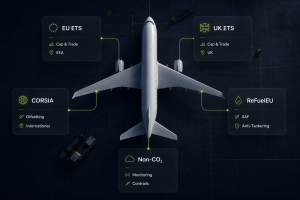
Aviation emissions compliance is uniquely painful because it is not one regulation – it is five. Each scheme has different scope, different deadlines, different calculation methods, and different penalties. An airline flying between Europe, the UK and the rest of the world can easily trigger three separate schemes on a single aircraft in a single day.
2026 is the year this gets serious. ReFuelEU enters its first year of real enforcement. Non-CO2 monitoring requirements are crystallising. Free carbon allowances under the EU ETS are approaching zero. Carbon prices are volatile, tied to energy markets, and moving daily – a single tonne of CO2 on the EU ETS has traded between EUR 55 and EUR 105 in the last two years.
“The airlines that treat 2026 as a data problem, not a trading problem, are the ones that will underprice their exposure.”
2. Five schemes, one aircraft. No excuses.
Here is a snapshot of every scheme your compliance team needs to manage. Most airlines handle each in isolation – different teams, different tools, different deadlines. That is where mistakes happen.
EU ETS
- Scope: within the EEA plus departing flights to Switzerland and the United Kingdom.
- Mechanism: cap & trade – buy and surrender allowances.
- Deadline: 30 September annually.
- Penalty: EUR 100/tonne (indexed to inflation).
- Status: mature – free allowances ending 2026.
UK ETS
- Scope: UK domestic and UK-EEA flights.
- Mechanism: separate cap & trade (post-Brexit).
- Deadline: 30 April annually.
- Penalty: GBP 100/tonne equivalent.
- Status: diverging from EU – different pricing.
CORSIA
- Scope: international flights (outside EU/UK ETS).
- Mechanism: offsetting above 85% of the 2019 baseline.
- Deadline: varies by state (typically Q1).
- Penalty: state-dependent.
- Status: mandatory from 2027 – 126 states participating.
ReFuelEU
- Scope: all flights departing EU airports.
- Mechanism: SAF blending mandates plus fuel uplift.
- Deadline: 31 March annually.
- Penalty: minimum 2x average fuel price per non-tanked tonne.
- Status: NEW – first enforcement year 2026.
Non-CO2
- Scope: intra-EEA flights (expanding 2027).
- Mechanism: MRV framework – monitoring and reporting.
- Deadline: annual (framework developing).
- Penalty: TBC – framework still crystallising.
- Status: emerging – monitoring from January 2025.
3. EU ETS: the end of free allowances
From 1 January 2026, aviation receives zero free allowances under the EU Emissions Trading System (with the exception of 20 million SAF-linked allowances). Every tonne of CO2 emitted on intra-EEA flights, plus departing flights to the UK and Switzerland, must be surrendered as an EUA purchased on the open market.
At recent EUA prices, that is a step change of hundreds of millions of euros in liability across the sector – and a direct hit to unit cost per ASK for any operator with heavy intra-European exposure. With supply tightening (8% fewer allowances in 2026 vs 2025) and demand growing, prices are projected to reach EUR 85/tonne in 2026 and cross EUR 100 by 2027.
Carbon price volatility is liability volatility
Carbon prices track energy markets, weather, geopolitics and regulatory announcements. Access to those markets is expensive for individual operators – most airlines do not have a dedicated carbon trading desk, so they lack real-time visibility into liability and price opportunities. The result is that the same emissions can produce very different bills depending purely on when allowances are bought.
4. ReFuelEU: the SAF mandate that changes everything
Officially part of the EU’s Fit for 55 package, ReFuelEU Aviation has applied since 2025, and 2026 is the first year many operators face a fuller operational compliance cycle. Regulators are still building out templates, guidance and verification practice, and there is significant disparity between Member States in how prepared their competent authorities are to enforce. The obligations apply now regardless.
ReFuelEU does two things that fundamentally reshape airline operations:
- It mandates that fuel suppliers blend increasing percentages of Sustainable Aviation Fuel (SAF) into conventional jet fuel at EU airports.
- It requires aircraft operators to uplift at least 90% of the aviation fuel required at Union airports on an annual aggregated basis – the anti-tankering provision.
The SAF blending trajectory: 2% to 70%
- 2025 – 2% minimum SAF share of jet fuel supply.
- 2030 – 6%.
- 2035 – 20%.
- 2040 – 34%.
- 2045 – 42%.
- 2050 – 70%.
The 90% rule: anti-tankering with teeth
Airlines that have been routinely filling up outside the EU to avoid higher fuel costs will now face direct penalties. If you are consistently fuelling up outside the EU to avoid SAF costs, that pattern shows up in the data. The 90% threshold is calculated per operator, per airport, and must be independently verified.
Switzerland formally adopted ReFuelEU on 1 January 2026, extending these requirements to Zurich and Geneva – a detail that has caught out several private jet and charter operators already.
Common ReFuelEU compliance pitfalls
- Fragmented fuel data – fuel uplift records scattered across multiple systems, airports, and handlers. ACMI agreements make retrieving arrival fuel data particularly challenging.
- Manual reconciliation – manual collection and reconciliation of post-flight data (block off, block on, fuel uplift) and planned fuel data (from the last signed operational flight plan).
- Template misalignment – fuel uplift density in Operations Manual A doesn’t always correspond to fuel uplift density used in flight scheduling software.
- Data gaps – gaps in planned fuel data create reporting holes that verifiers will flag and regulators won’t accept.
If you surpassed the reporting thresholds in 2025 (more than 500 commercial passenger flights or 52 all-cargo flights departing EU airports), your monitoring and reporting process needs to be locked down for 2026. Reports must be verified by an accredited independent verifier and submitted by 31 March.
5. SAF economics: the cost of compliance vs the cost of ignoring it
SAF costs 2-5x more than conventional jet fuel. That is a real cost. But the penalty for non-compliance costs more.
- Conventional jet fuel – approximately EUR 320/tonne.
- SAF (biofuel) – approximately EUR 800-1,200/tonne.
- Non-compliance penalty – approximately EUR 1,500/tonne minimum.
The penalty is not just a fine – it is a floor. It is calculated as a minimum of twice the yearly average price of aviation fuel multiplied by the total non-tanked quantity. Some Member States may impose higher penalties. And crucially, paying the penalty does not eliminate the compliance obligation – you still owe the fuel uplift.
6. Non-CO2: the hidden two-thirds of aviation’s climate impact
Roughly two-thirds of aviation’s total climate impact comes from non-CO2 effects – not the carbon everyone has been measuring.
The entire EU ETS – years of allowance trading, billions in compliance costs, an entire carbon market – covers roughly one-third of aviation’s actual warming contribution. The other two-thirds has been invisible to regulation. Until now.
What non-CO2 actually means
- Contrails and contrail cirrus – accounts for up to 57% of aviation’s total climate impact. Thin ice clouds formed by engine exhaust that trap heat. Highly variable depending on altitude, humidity, and time of day.
- NOx emissions – nitrogen oxides create ozone (warming) and destroy methane (cooling). The net effect is warming, but the chemistry is complex and altitude-dependent.
- Water vapour – direct emission of water vapour at cruise altitude contributes to atmospheric warming. Small individual effect but cumulative across the global fleet.
- Particulate matter – soot and aerosol particles affect cloud formation and atmospheric chemistry. Increasingly recognised as a significant non-CO2 factor.
Where the regulation stands
The EU has established a Monitoring, Reporting and Verification (MRV) framework for non-CO2 effects. From January 2025, airline operators must monitor and report non-CO2 aviation effects for all routes involving two aerodromes in the EEA, plus routes from EEA airports to Switzerland and the UK. First reports are due in 2026.
From January 2027 this expands to mandatory monitoring and reporting for all inbound and outbound flights to the EEA. By end of 2027 the Commission will deliver a report on the results, potentially followed by a legislative proposal to actively regulate – not just monitor – non-CO2 effects.
Operators will need:
- Per-flight fuel burn and NOx emissions data.
- Contrail formation modelling using flight trajectory and meteorological data.
- Independent verification of the methodology used.
7. CORSIA and UK ETS: overlapping jurisdictions
CORSIA’s first mandatory phase runs 2024-2026, covering international flights between participating states. Airlines must offset emissions growth above 85% of the 2019 baseline using eligible emissions units – and the eligible unit pool is thinner than most operators assumed when CORSIA was designed. The scheme becomes fully mandatory in 2027 with 126 states participating.
UK ETS operates in parallel to EU ETS for departures from UK airports. The two schemes share methodology but not allowances – an EUA cannot be surrendered against a UK obligation, and vice versa. Multi-jurisdiction operators effectively run two carbon books.
Which routes trigger which scheme?
- Frankfurt to Madrid – EU ETS.
- Paris to Zurich – EU ETS.
- London to Paris – UK ETS.
- Manchester to London – UK ETS.
- London to New York – CORSIA.
- Frankfurt to Dubai – CORSIA.
Same airline, same day, three different compliance schemes. A carrier flying London-Paris-Dubai in a single day triggers UK ETS, EU ETS, and CORSIA – each with different calculation methods, different deadlines, and different reporting formats.
8. The 2026 aviation compliance calendar
One of the most common mistakes in multi-scheme compliance is missing a deadline because the team was focused on a different scheme’s reporting cycle. The key dates to hold on the wall:
- 31 March 2026 – ReFuelEU annual verified report submission.
- 31 March 2026 – EU ETS verified emissions report due.
- 30 April 2026 – UK ETS allowance surrender deadline.
- 30 June 2026 – Non-CO2 MRV data submission.
- 30 September 2026 – EU ETS allowance surrender deadline.
- Q4 2026 – CORSIA offset purchase window.
- 31 December 2026 – CORSIA Phase 1 offsetting obligation.
9. Carbon trading and liability management
Carbon is a financial instrument. It trades on exchanges. Its price fluctuates daily. Your carbon liability is not a fixed number – it is a moving target. Yet most airlines treat carbon purchasing like buying office supplies: wait until the deadline, check the price, pay whatever it costs. That is not compliance management. That is financial negligence.
The EUR 1.3 million difference
Say your airline emits 100,000 tonnes of CO2 in a compliance year. The difference between buying allowances at EUR 65/tonne (a dip in October) versus EUR 78/tonne (a spike in January) is EUR 1,300,000. Same emissions, same compliance outcome, seven-figure delta based purely on timing.
How smart operators buy carbon differently
- They monitor daily. They know their carbon liability today – not last quarter, not last year. They have a live view of emitted CO2, current market price, and total financial exposure. When the market dips, they know immediately.
- They forecast forward. They model their emissions forward based on route schedules, fleet plans, and seasonal patterns. They know roughly how many allowances they’ll need before the year starts, and they build a purchasing plan accordingly.
- They use the right tools. They don’t manage carbon liability on spreadsheets any more than they’d manage fuel hedging on a whiteboard. They use purpose-built platforms that connect live market data to their operational emissions.
The ETS market is also becoming more complex. With Swiss ETS aligning to the EU system, UK ETS pricing diverging, and CORSIA offset markets maturing, airlines operating across multiple jurisdictions need a consolidated view of their total carbon financial exposure – not separate spreadsheets for each scheme.
10. Why this matters in 2026
The window for manual compliance management in aviation is closing. Here is what is converging this year:
- Free allowances are gone. Airlines must now purchase 100% of their EU ETS allowances at market price.
- ReFuelEU is being enforced. The first full reporting cycle is underway. The interpretation phase is over.
- Non-CO2 monitoring is live. Airlines must monitor and report non-CO2 effects for intra-EEA flights. First reports fall due in 2026.
- CORSIA goes mandatory in 2027. The global offsetting scheme transitions from voluntary to mandatory next year, covering 85% of international aviation emissions.
- Carbon prices are rising. With supply tightening (8% fewer allowances in 2026) and demand growing, prices are projected to reach EUR 85/tonne in 2026 and cross EUR 100 by 2027.
- 2% to 70% – SAF blending mandate growth over the next 25 years.
- Zero – free carbon allowances by 2026, everything at market price.
- EUR 85/tonne – projected average EU ETS carbon price for 2026.

What to do now: a 2026 action checklist
- Model your 2026 EUA exposure at current market prices and stress-test at +30% and +50%.
- Audit fuel uplift by airport to identify airports at risk of breaching the 90% ReFuelEU threshold.
- Start non-CO2 data capture immediately – even a partial 2025 dataset is better than starting from scratch in Q4.
- Consolidate reporting across schemes so you are not running five parallel spreadsheets that cannot reconcile against each other.
- Treat carbon as a financial instrument – build a purchasing plan, not a deadline scramble.
11. Frequently asked questions
What is the EU ETS 90% rule under ReFuelEU?
Aircraft operators must uplift at least 90% of the aviation fuel required at each Union airport on an annual aggregated basis. It is the anti-tankering provision designed to prevent airlines from fuelling outside the EU to avoid SAF costs.
When do free EU ETS aviation allowances end?
Free EU ETS allowances for aviation phase out completely in 2026. From 1 January 2026 airlines must purchase 100% of their allowances at market price, with the exception of 20 million SAF-linked allowances.
When does CORSIA become mandatory?
CORSIA transitions from voluntary to mandatory in 2027. The first mandatory phase covers 2024-2026, and 126 states are currently participating.
What is the ReFuelEU non-compliance penalty?
A minimum of twice the yearly average price of aviation fuel multiplied by the total non-tanked quantity – approximately EUR 1,500 per tonne at current prices. Paying the penalty does not discharge the compliance obligation; you still owe the uplift.
Does UK ETS accept EU ETS allowances?
No. UK ETS and EU ETS share methodology but not allowances. An EUA cannot be surrendered against a UK ETS obligation, so multi-jurisdiction operators effectively run two carbon books.
One platform. Every scheme.
ETS.aero calculates roughly EUR 2 billion in annual carbon liability across the airlines we serve – EU ETS, UK ETS, CORSIA, ReFuelEU and Non-CO2 in one MRV hub.